
Dollar, euro, ruble, pound: your currency against the shekel in July 2026
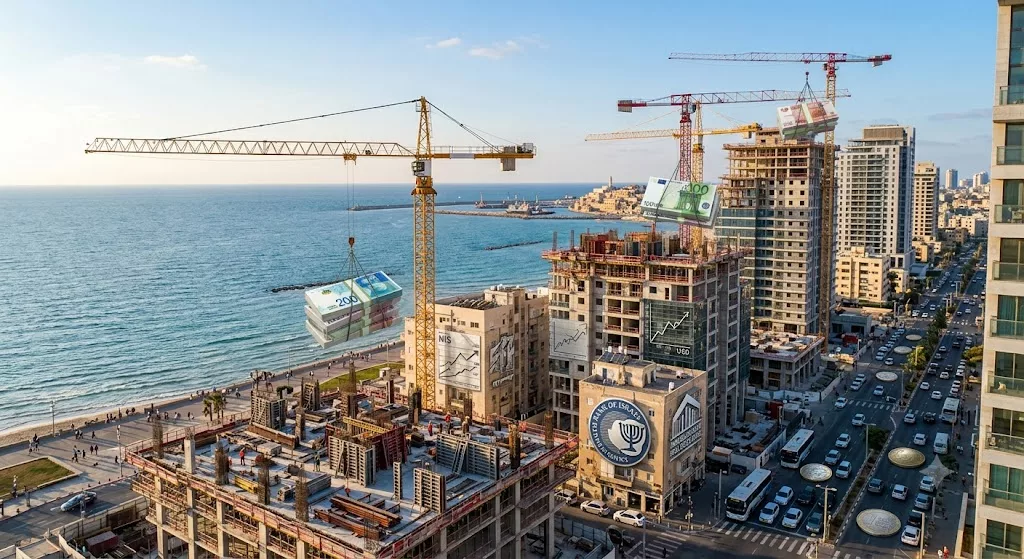
In October 2023, buying a three-room apartment in Tel Aviv for 3.5 million shekels cost approximately $858,000. In July 2026, that same apartment — without having moved a penny in terms of its shekel price — comes to $1,167,000. The difference? It lies not in Israeli real estate, but in the shekel itself, which has become one of the world's best-performing currencies since the end of the Gaza conflict. For diaspora buyers — whether they live in New York, Paris, London, Berlin, or Moscow — understanding this exchange rate dynamic is not a side issue: it is the factor that can turn an opportunity into a miscalculation, or vice versa.
The shekel since 2023: a currency that has weathered everything
At the height of geopolitical uncertainty, in October 2023, the dollar had climbed to 4.08 shekels. The euro reached 4.25 shekels. That was the moment when markets were anticipating the worst. The shekel had collapsed against almost all major world currencies. Today, the situation is radically reversed.
In July 2026, the dollar trades at around 3.00 shekels — a depreciation of 26.5% over two and a half years. Over the past twelve months, the dollar has lost 10.3% against the shekel. The euro has fallen even further: from 4.25 shekels last summer to 3.41 shekels today, a decline of -15.6% in one year. The British pound holds up slightly better, at 3.96 shekels. As for the ruble, it now takes 25.7 rubles to buy a single shekel.
This trajectory reflects several concurrent realities: the resilience of the Israeli economy, the strength of its technology sector, and the cautious monetary policy of the Bank of Israel, which has maintained its benchmark rate at 3.75% since May 2026. The shekel is no longer just the currency of a small Middle Eastern country — it has now become a regional safe-haven currency.
For dollar buyers: American, Canadian, and Latin American communities
The American Jewish community is historically the largest group of foreign buyers in Israel. It was also, since 2023, the most protected by the favorable exchange rate. That shield has now disappeared.
An apartment priced at 2,000,000 NIS was worth $490,000 in October 2023. It is worth $667,000 today. The gap: an additional $177,000, representing a 36% increase in real cost for a dollar buyer — without the shekel price having changed one iota.
Seen from the other direction: a budget of $500,000 could buy 2,040,000 shekels' worth of property in 2023. That same budget now only buys 1,500,000 shekels in July 2026 — a loss of purchasing power of 540,000 shekels, equivalent to an extra bedroom in some cities.
For Latin American buyers whose local currency often tracks the dollar (Brazil, Argentina, Mexico), the situation is similar or even more complex, as their national currencies have themselves lost ground against the dollar in recent years.
For euro and pound buyers: French, German, and British communities
The euro has experienced an even sharper correction. A year ago, one euro exchanged for 4.25 shekels. Today: 3.41 shekels. Over twelve months, the euro has lost -15.6% against the shekel — more than the dollar over the same period.
Concretely, an apartment priced at 2,000,000 NIS cost 471,000 euros last summer. It costs 587,000 euros today. The difference amounts to approximately 116,000 euros more, representing around +25% in real cost for a euro buyer. For communities — French, Belgian, German, Swiss — that viewed Israel as a still-accessible market, this shift changes the calculation.
The British pound, more stable, offers slightly greater purchasing power: 1 GBP exchanges for 3.96 shekels. An apartment priced at 2 million shekels thus represents approximately £505,000. The British Jewish community, traditionally present in Netanya and the northern neighborhoods of Tel Aviv, benefits from a relative advantage over euro buyers.
For the German-speaking community (Germany, Austria, Switzerland), the evolution of the euro has created a particularly noticeable scissors effect: real estate prices in Israel have continued to rise in shekels over the years, and the exchange rate now amplifies this increase. Some observers note that the average German buyer today pays in euros a price comparable to that of an equivalent property in major German cities — a reversal of the situation compared to 2020.
For ruble buyers: the Russian-speaking community
The situation for ruble buyers is different in nature. The ruble is not a freely convertible currency, and international real estate transactions from Russia have been subject to complex regulatory restrictions since 2022. The Russian-speaking community buying in Israel is mostly made up of people already settled there or holding income in Western currencies.
For those whose assets are in rubles, the picture is stark: 1 shekel exchanges for 25.7 rubles. An apartment priced at 2,000,000 shekels thus represents approximately 51 million rubles. The Russian-speaking community in Israel — which numbers more than one million people — is therefore primarily concerned as sellers or already-local investors, rather than as new buyers from abroad.
When is the right time to buy depending on your currency?
The question all potential buyers ask is one of timing: should you buy now, or wait for an exchange rate reversal? The answer depends on your currency, your investment horizon, and your analysis of the regional economic fundamentals.
For a dollar buyer, the favorable window of 2023–2024 is clearly closed. The dollar has lost more than a quarter of its value against the shekel since the October 2023 peak. Several economists anticipate stabilization around 2.90–3.10 NIS per dollar by end of 2026, suggesting that a waiting strategy will not necessarily pay off. Conversely, if US financial markets were to go through a period of stress, the dollar could temporarily strengthen.
For a euro buyer, the -15.6% drop over twelve months is exceptional. Historically, such sharp corrections in EUR/NIS are followed by phases of stabilization. However, there is no indication of a structural rebound of the euro against an Israeli economy that continues to outperform the eurozone in terms of GDP growth.
A strategy often adopted by savvy diaspora buyers is to gradually convert their savings into shekels over several months — what is known as 'exchange rate averaging' — rather than converting the entire amount at the time of the transaction. Some Israeli banks offer foreign currency accounts that allow the conversion to be deferred. It is recommended to consult a specialized financial advisor before making any decision, as tax rules and restrictions vary by country of residence. For further information on the legal and practical framework for buying from abroad, our complete guide for foreign buyers in Israel details the essential steps and precautions.
In all cases, it is important to note that the Bank of Israel actively monitors the exchange rate and has intervened on several occasions to prevent too sharp an appreciation of the shekel. This implicit safety net limits extreme movements in both directions.
What this concretely changes for your purchasing decisions
The key takeaway: since late 2023, buying in Israel has become significantly more expensive in foreign currency — not because the Israeli real estate market has exploded beyond reason, but because the shekel has structurally strengthened. This reality profoundly alters the comparison with other international real estate markets.
For dollar buyers, the 2023 parity (more than 4 NIS to the dollar) is now a memory. For euro buyers, the fall of the euro in 2025–2026 has erased the comparative advantage that the European currency offered. For pound sterling buyers, the situation remains relatively more favorable.
That said, the fundamentals of the Israeli real estate market remain solid: a structural housing shortage, rising demographics, a resilient economy, and public construction policies struggling to keep pace with demand. Real estate in Israel is not only compared to other investment destinations — for many diaspora buyers, it also responds to a logic of identity and family connection that the exchange rate does not quantify.
The real question is not 'is it still affordable?' but 'at what rate and under what conditions is it optimal to buy?' A question to ask your advisor, with July 2026's figures in hand.
Are you considering buying in Israel from abroad? Browse listings and resources available on Immobilier.co.il, the portal dedicated to diaspora buyers.


