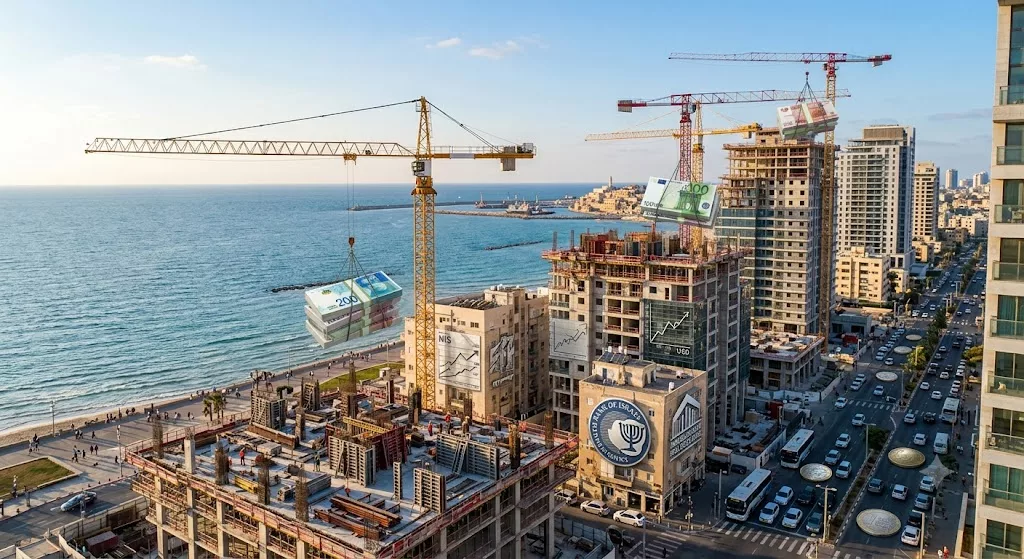
8% Purchase Tax: What the 2026 Reform Changes for Foreign Buyers

For a diaspora Jew preparing to buy in Israel — whether living in New York, Paris, London, Berlin, Moscow, or Buenos Aires — the first line of the budget is not the price of the apartment. It's the purchase tax. And since the Arrangements Law came into effect in mid-February 2026, the rules have changed. New brackets, land registry reform, a spectacular tax gap between those who made aliyah and those who buy while remaining foreign residents: here is what you need to understand, with figures to back it up, before signing.
The February 2026 Reform, in Brief
The Arrangements Law 2026 has redrawn the brackets of the Mas Rechisha (the Israeli purchase tax), recalibrated the exemption thresholds for first-time buyers and new immigrants, and modernized the registration procedure at the Tabou (the land registry). The set scales apply over a multi-year period, which finally gives visibility to foreign buyers planning over several months.
The fundamental principle remains unchanged: a foreigner can buy in Israel with property rights nearly identical to those of a resident. The difference is not legal — it is fiscal. And it is significant.
8% From the First Shekel: The Real Cost for a Non-Resident
A non-resident buyer — or any investor purchasing an additional property — is taxed at 8% from the first shekel, up to 6,055,070 NIS (approximately 1,985,000 USD), then 10% beyond that. There is no 0% bracket, no entry-level allowance.
Let's take an apartment at 3,000,000 NIS (approximately 984,000 USD, based on 1 USD = 3.05 NIS). The purchase tax for a foreign buyer amounts to 8% of the total, i.e., 240,000 NIS, or nearly 78,700 USD. On a property at 2,000,000 NIS (656,000 USD), the bill is already 160,000 NIS (52,500 USD). This sum is added to the price, the down payment, and the lawyer and broker fees. Many diaspora buyers discover it too late in their financing plan.
Oleh Status: The Tax Gap That Changes Everything
This is where the reform makes the most sense for the diaspora. The new immigrant (oleh) benefits from a radically more favorable regime for their sole residence: 0% up to 1,978,745 NIS, then only 0.5% up to 6,055,070 NIS. This rate applies once per household, for a purchase made between one year before and seven years after aliyah.
Let's return to our 3,000,000 NIS apartment. Where the non-resident pays 240,000 NIS, the oleh pays only the fraction above the exempt threshold at 0.5%, which is approximately 5,100 NIS (1,670 USD). The gap exceeds 234,000 NIS — nearly 77,000 USD — on one and the same property. This is often the equivalent of a year's income, or a fully renovated kitchen and bathroom.
The message is the same for a buyer from Los Angeles, Milan, or Saint Petersburg: the aliyah timeline and the purchase timeline deserve to be planned together. For some families, delaying the signing by a few months to coincide with oleh status represents the most significant tax saving of the entire project.
Beyond the Purchase Tax: Capital Gains, Development Levies, and the Digitalized Tabou
The purchase tax is not the only tax item. Three other elements deserve the attention of the foreign buyer:
Mas Shevach (capital gains tax): 25% on the real gain, adjusted for inflation, at the time of resale. It mainly concerns the investor who buys to resell in the medium term.
Hetel Hashbacha (development levy): when a local planning committee approves a change that increases the value of a property — rezoning, additional building rights — the municipality can levy up to 50% of the added value. This is a crucial point for anyone buying in an area affected by an urban renewal project.
The Tabou Reform: since 2026, the majority of standard residential property transfers are processed via electronic submission through the land registry portal. The expected result: faster processing of standard files, but additional compliance steps for cross-border transactions — that is, precisely those of diaspora buyers. Registration fees have also been recalibrated, with a slight increase on high-end properties.
What the Diaspora Must Keep in Mind Before Signing
Three key reflexes are essential. First, factor in the purchase tax from the very first budget simulation, never after: on a property worth 3 million shekels, it represents 8% of the price for a non-resident. Next, assess your status: an aliyah project, even in the medium term, can transform a bill of 240,000 NIS into a few thousand shekels. Finally, file on time: the purchase tax declaration must be submitted to the Israeli tax authorities within 30 days of signing (payment is due within 60 days), with supporting documents for any reduced rate.
These rules are the same for everyone, regardless of nationality. This is what makes the subject universal: the tax divide in Israel does not separate French buyers from Americans or Latinos — it separates residents and olim from buyers who remain non-residents. For a complete overview of the buying process, from search to key handover, consult our ultimate guide to real estate in Israel.
Conclusion
The 2026 reform has not closed the door to foreign buyers: it has simply made the entry cost more transparent — and higher for those who buy without resident status. When properly anticipated, Israeli taxation can be planned for; when poorly anticipated, it derails a budget. The good news is that every situation has its optimal strategy, provided it is built before signing, not after.
Are you preparing to buy in Israel from abroad? Estimate your actual purchase tax and get guidance from local professionals at immobilier.co.il.
Indicative exchange rate: 1 USD = 3.05 NIS (July 2026). Tax scales and thresholds are subject to change; this article is for informational purposes only and does not constitute personalized tax or legal advice.